
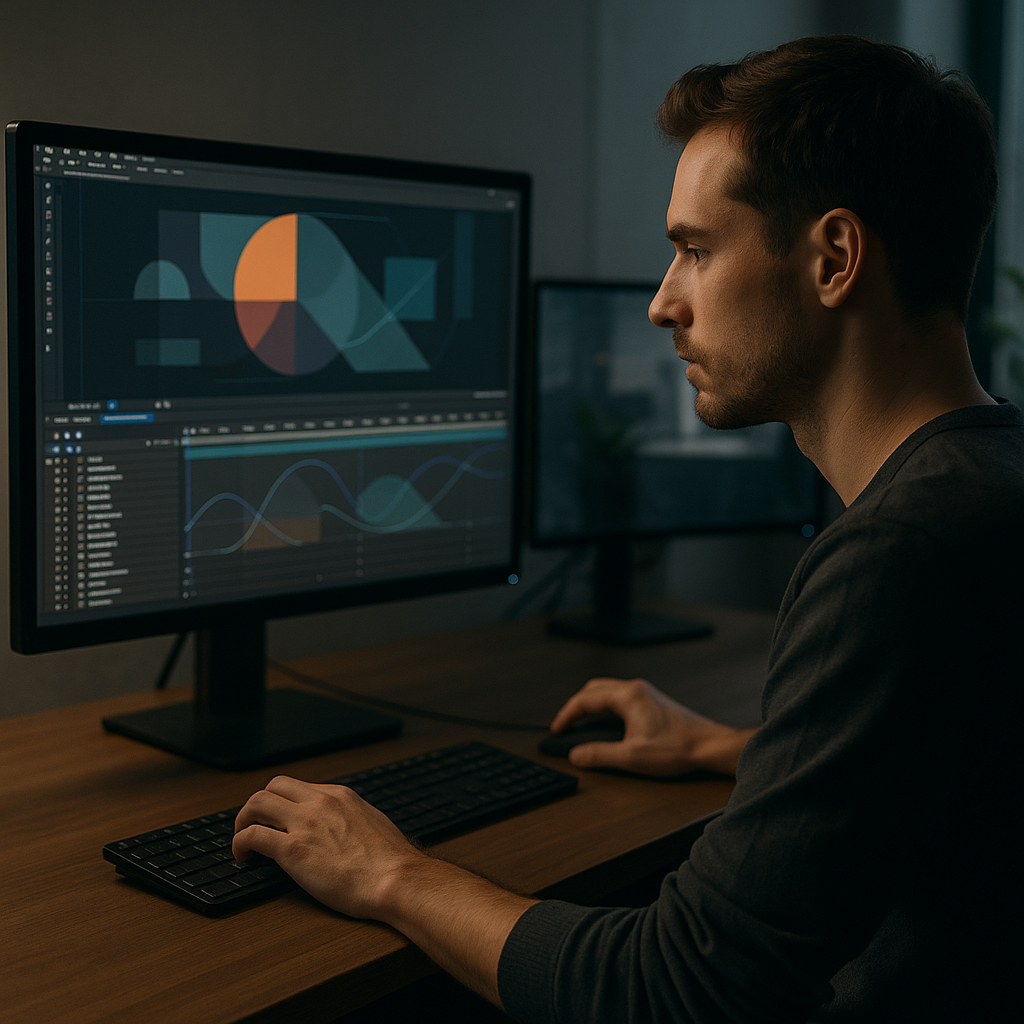
If you work in video, editing, or content creation, motion design is one of the most valuable skills you can add to your toolkit. This guide shows you how to get into motion design using practical workflows built around Adobe After Effects, templates, and real client needs, so you can move from curious beginner to reliable motion designer. Explore motion design plans
What Motion Design Is And Why It Matters
Defining motion design
Motion design is the craft of combining graphic design, animation, and timing to create moving visuals with a clear purpose. It lives inside intros, lower thirds, titles, UI animations, lyric videos, product explainers, and social content. If you have ever watched a YouTube intro or app promo, you have seen motion design at work.
How motion design fits into video work
For editors and content creators, motion design connects the gaps between cuts. It adds structure, branding, and clarity so viewers always know what they are looking at and why. Instead of only trimming clips, you shape how information appears through animated typography, shapes, transitions, and on-screen widgets.
Why After Effects is the core tool
Adobe After Effects is the standard for motion design because it combines keyframe animation, compositing, effects, and expressions in a single workspace. Whether you are animating simple lower thirds or building complex UI scenes like a stylized map widget animation, After Effects gives you frame-level control over every detail.
Who motion design is for
Motion design is a strong fit if you:
- Edit content for YouTube, TikTok, or Reels and want more polished animations.
- Work in marketing and need branded titles, callouts, and explainers.
- Are a designer who wants to bring static layouts to life.
- Are a freelancer who wants higher-value projects than basic editing.
Why motion design is a good career move
Demand for motion design grows wherever video grows: social media, SaaS, finance, music, games, and education. Brands rely on motion designers to keep visuals consistent across campaigns, platforms, and regions. Because the skill set is software-based, you can work worldwide with clients who just need your project files and exported videos.
Motion Design Career Guide From Roles To Styles
Understanding different motion design roles
A solid motion design career guide starts by clarifying the main roles you can aim for. Common paths include:
- Motion graphics designer – creates titles, lower thirds, logo animations, and explainer visuals.
- Video editor with motion skills – edits footage and adds animations, perfect for YouTube and content studios.
- UI/UX motion designer – focuses on micro-interactions and app/product animations.
- Broadcast or social graphics designer – builds packages for shows, channels, and social brands.
Common motion design project types
To understand how to get into motion design, it helps to see the recurring project categories you will meet:
- Widget-style overlays – animated UI elements like price tags, app stats, or finance dashboards. For example, a banking overlay similar to a payment widget animation.
- Music and lyric videos – synced typography and visualizers, like stylized tracks or animated lyrics.
- Social promos and stories – bold text, transitions, and product callouts optimised for vertical formats.
- Explainers and product demos – animated icons, diagrams, and UI flows.
- Branded intros and lower thirds – logo stings, packshots, and name/title bars.
Core styles and aesthetics
Within these project types, you will find recurring visual styles:
- Flat and minimal – simple shapes, solid colors, clean easing.
- Digital and UI – dashboards, cards, maps, notifications, widgets.
- Music-driven – responsive typography and visuals mapped to beats, like a stylized track similar in feel to music-inspired motion pieces.
- Cinematic and abstract – liquid, glass, or particle-based animations.
How project types shape your career
Picking a lane early helps your portfolio feel coherent. For example:
- If you like apps and fintech, focus on UI and finance widgets.
- If you enjoy music and lyrics, build a set of lyric and visualizer projects.
- If you love short-form content, specialise in reels/shorts templates and transitions.
Using templates to explore styles
Exploring pre-built projects lets you see how professionals structure timelines, comps, and expressions. Opening various widget or lyric files from collections like the ones found in the After Effects video templates library can teach you more in an afternoon than a theory-only course. You can study keyframes, precomps, naming, and timing decisions directly inside After Effects.
Frequent Beginner Mistakes In After Effects
Messy compositions and naming
One of the biggest early mistakes when learning how to get into motion design is working in a single, chaotic composition. Everything sits on one timeline with default layer names like “Shape Layer 23” or “Pre-comp 12”. This slows you down and makes revisions almost impossible.
- Use clear names for comps: Main_Edit_1080p_25fps, LowerThird_Template.
- Group related layers into precomps like Title_Text, Background_Gradient.
- Color label your layers by function (text, background, controls).
Ignoring frame rate and resolution
Importing all kinds of footage into a default 29.97 fps comp, then exporting at 25 fps, leads to jittery motion and off-beat animation. Before animating, confirm:
- Sequence fps matches the platform (25 fps for EU broadcast, 30 fps for many social workflows).
- Comp resolution fits the output: 1920×1080, 1080×1920, or square formats.
Overusing heavy effects and plugins
New motion designers often stack glows, blurs, and particles on every layer. This can crush preview performance and make deadlines stressful.
- Ask whether each effect helps the story or just adds noise.
- Prefer simple shapes, masks, and gradients over multiple third-party effects.
- Pre-render heavy sections when needed instead of stacking everything live.
Poor timing and easing
Another common issue is using only linear keyframes, or dragging the Graph Editor randomly. Results feel robotic or inconsistent.
- Use Easy Ease (F9) as a baseline.
- In the speed graph, make motion start fast and end slow for more natural moves.
- Sync main beats like logo reveals and key text to music or VO accents.
Ignoring motion blur and overshoot
Turning motion blur off globally, or setting it extremely high, both cause problems. Without blur, animations feel rigid. With too much, elements look smeared.
- Enable per-layer motion blur only where fast movement happens.
- Use small overshoots and subtle secondary motion rather than extreme bounces.
Not planning before animating
Jumping straight into keyframes without a plan often produces cluttered layouts. You spend more time fixing than creating.
- Sketch or block out animation beats using simple solids.
- Define entry, hold, and exit times for each key element.
- Lock design decisions before polishing transitions and details.
Underestimating render and export
Leaving export decisions to the final minute can cause late deliveries or unexpected quality issues. Always test a short render early to confirm playback and compression.
Choosing The Right Approach For Each Motion Design Project
Start from the final platform
When planning any motion design piece, first define where it will live: TikTok, YouTube, broadcast, or app UI. The platform informs aspect ratio, duration, pacing, and complexity. A 7-second vertical ad needs faster reads and bolder typography than a 2-minute explainer.
Social reels and shorts
For vertical content, you want:
- Large, high-contrast text that stays readable on small screens.
- Fast transitions, but not so fast that viewers miss key messages.
- Simple backgrounds so content remains clear even with compression.
Reusable title cards and callout templates are helpful here. You can create a system once, then drop it on multiple edits with minor customizations.
YouTube and long-form content
For longer videos, you need consistency more than constant novelty. Build:
- A recurring intro and outro animation.
- Reusable lower thirds for hosts and guests.
- Call-to-action popups and data widgets that can be reused across episodes.
Ads and product promos
For product spots, every animation choice should support clarity and conversion:
- Highlight key benefits with animated text and icons.
- Use on-brand colors and typography.
- Guide the eye from feature to feature with smooth camera moves or transitions.
Corporate and UI/UX presentations
Here, motion design should feel calm, precise, and reliable. You might animate dashboards, app screens, or payment flows in a style similar to an animated digital finance interface sequence. Focus on:
- Clean, minimal transitions.
- Readable data and labels.
- Subtle emphasis instead of flashy effects.
Using templates to speed decisions
If you are new and unsure which layout or style fits a project, prebuilt After Effects templates help you test ideas quickly. You can drop client copy and logos into several concepts and see which timing and design works best before committing to a full custom build.
Evaluating your options
When facing a brief, ask:
- Does this need a bespoke animation system or a flexible template?
- How often will the client reuse these graphics?
- Is speed more important than full originality for this job?
If you need reference and structure for your own style, browsing curated motion portfolios on Behance is a practical way to see how professionals solve similar problems with clean layouts, timing, and color decisions. This also helps you set realistic quality benchmarks for your own work.
Practical Template Workflow Guide For After Effects
Start with compatibility checks
Before you animate or customize any template, confirm the technical basics:
- After Effects version – Make sure the project supports your installed version. If your software is newer, open in a test folder and save under a new name.
- Frame rate – Match the template fps to your final output or editing timeline. If the template is 30 fps but your sequence is 25 fps, consider converting early.
- Resolution and format – Check comp sizes: 1920×1080, 4K, vertical 1080×1920, or square. If needed, duplicate master comps and adjust for alternate formats.
Understand the project structure
Well-built templates usually follow a clean structure:
- Master render comps – final outputs only.
- Edit or scene comps – individual scenes or shots.
- Assets and controls – folders for fonts, colors, and controllers.
Spend a few minutes exploring timelines and soloing layers. For instance, a UI widget template similar to an animated video platform stats card will likely use precomps for icons, text, and backgrounds, with a central control layer for colors and timing.
Organise keyframes and precomps
When customising or extending templates, keep the logic intact:
- Rename any duplicated precomps clearly (e.g., Widget_01, Widget_02).
- Use guide layers or nulls as global controllers for movement or color.
- Keep user-editable layers near the top of the stack and lock complex rig layers when not needed.
Smart naming conventions
Clean naming speeds up revisions and collaboration:
- Prefix layers based on type: TXT_, BG_, ICON_, CTRL_.
- Document your logic in a small guide layer inside the main comp.
- Color-code layers by function: controls one color, backgrounds another, text a third.
Performance and preview tips
Heavy templates and full-HD scenes can lag. To stay responsive:
- Lower preview resolution to half or quarter when blocking animation.
- Use the region of interest to focus on specific zones.
- Enable cache before playback and clear it if previews become glitchy.
- Create proxies for large footage or 3D elements that do not need full resolution during layout.
Handle plugin dependencies carefully
Some templates rely on third-party plugins. When you open the file, After Effects will flag missing effects.
- If the missing plugin only affects small details (like glow), consider replacing it with a native effect.
- If the plugin is central to the look, evaluate whether buying it makes sense for your workflow volume.
- Aim to build or select templates that primarily rely on native effects for maximum stability.
Customization workflow step by step
For any template, a reliable workflow looks like this:
- Step 1 – Duplicate master comps
Create a working version so you can revert if needed. - Step 2 – Update controls
Change colors, fonts, and global settings first using dedicated controller layers or expression-linked controls. - Step 3 – Replace content
Swap text, images, and logos in their designated precomps. Check alignment at key moments. - Step 4 – Adjust timing
Use markers and keyframe groups to retime sections. Keep main beats consistent with the music or VO. - Step 5 – Add bespoke touches
Introduce small, unique moves or accents so similar templates for different clients do not look identical.
Use-case examples
Here is how you might adapt templates across different project types:
- Reels and shorts – Use bold, punchy transitions, variable-speed type animations, and quick widgets that highlight numbers or reactions.
- Ads and promos – Customize color systems, product shots, and feature callouts; ensure each beat matches a benefit.
- Music and lyrics – Align text reveals to beats and phrases, build visual motifs that evolve across verses, and use subtle background motion. A stylised track similar to animated lyric visuals can be a strong portfolio centrepiece.
- Cinematic edits – Keep motion slower and more deliberate, with gradients, blurs, and light leaks that support the footage mood.
Building your own template library
Over time, treat every successful project as a future template. Clean it up, centralize controls, and save a master version without client branding. You end up with an internal library covering widgets, lower thirds, transitions, and lyric styles that lets you deliver new projects much faster.
Advanced Workflow And Long Term Optimization
Create reusable animation systems
Rather than reinventing animation from scratch for every job, build systems that can adapt across projects:
- Standardize text in/out animations for titles and lower thirds.
- Develop a set of modular transitions you can drop between scenes.
- Design a few core widgets (stats, maps, notifications) that can be re-skinned per client.
Studying how a self-contained overlay, such as a stylized game-themed widget animation, is built can inspire robust, modular setups in your own projects.
Keep visual consistency across edits
For series or channels, consistency is more important than one-off flair. To maintain it:
- Define a style guide: colors, fonts, motion curves, and transition types.
- Create a central control comp or Essential Graphics panel for key brand elements.
- Use the same easing presets and blur levels across episodes.
Use styleframes and motion tests
Before building full timelines, create a small set of styleframes (static compositions showing key moments) and 3–5 second motion tests. This avoids big reworks later because clients and collaborators can approve the look and feel early.
Quality control checklist
Before rendering, run through a quick QC list:
- Check for spelling issues in all text layers.
- Confirm safe margins so important content is not cut off on some screens.
- Verify that every comp uses the correct fps and resolution.
- Scan for broken expressions, missing fonts, or missing footage.
- Preview critical moments at full resolution to catch flicker or banding.
Export and render strategies
Long renders can block your machine at crunch time. To stay efficient:
- Pre-render heavy sections and re-import them as clips for the final pass.
- Use visually lossless intermediate codecs when going to a separate editing app.
- Organize output modules and templates in the Render Queue to avoid re-creating settings for each job.
Dynamic link and project size
Dynamic Link between After Effects and editing software can be powerful, but also risky if overused:
- Use it for short, frequently revised segments, not entire films.
- If a comp is final, consider rendering it to a file instead of keeping it live-linked.
- Regularly collect files and archive completed projects to keep active folders lightweight.
Planning for growth
As your motion design work scales, aim to:
- Create documented templates and presets for recurring clients.
- Standardize folder structures across all projects.
- Keep a personal log of what worked or failed on each job so future projects benefit from past experience.
Search Intent Guide For Motion Design And After Effects
Map common questions to skills
When people search for how to get into motion design, they usually mean one of several things. Matching these intents helps you focus your learning and portfolio.
- “What software do I need for motion design”
Usually, this means choosing between editing tools and dedicated motion tools. For professional work, After Effects plus a basic NLE is a solid core setup. - “How do I learn keyframing and easing”
Searchers here want hands-on practice. The best response is to animate simple shapes and text at first, focusing on spacing and timing rather than heavy effects. - “How do I make YouTube intros and lower thirds”
They are looking for repeatable graphics. You can build or use templates for logo animations, name bars, and subscribe popups, and then customize them per channel. - “How do I sync animations to music”
This intent is about lyric videos, visualizers, and beat-driven graphics. Practise by placing markers on the audio layer and aligning your key actions and transitions accordingly. - “How can I get client work in motion design”
Here, the goal is career-building. The most efficient route is to finish 4–6 focused portfolio pieces showing specific problems solved: UI walkthroughs, product explainers, lyric segments, or data-driven overlays. - “Do I need drawing skills for motion design”
Many motion jobs rely more on typography, layout, and timing than illustration. You can focus on clean type, grids, and simple shapes and still build a strong career.
Align practice projects with search intent
Use these intents as prompts for your own exercises: build a “YouTube intro” sequence, a short “UI walkthrough” for a fictional app, or a “lyric snippet” synced to eight bars of a track. Each project becomes both practice and future portfolio material.
Worldwide opportunities
Because motion design is file-based, you can collaborate with clients worldwide through shared project files, cloud drives, and revision exports. Good organisation, clean templates, and predictable timelines matter as much as creative flair when working remotely.
Bringing It Together And Planning Your Next Steps
Summarise your learning path
To build a real motion design career, your focus should be clear: understand the fundamentals of timing and design, practice inside After Effects, and gradually assemble a portfolio of repeatable, client-ready pieces. Each project should teach you something new about compositing, typography, or pacing.
Combine templates with custom work
Templates and preset systems are not shortcuts around learning; they are accelerators for it. Opening finished projects shows you how professionals structure comps, use controllers, and manage timing, while your own custom adjustments sharpen your judgment about what actually works on screen.
Build a focused portfolio
Instead of chasing every style, select a few areas that match the type of clients you want: UI dashboards, social packages, lyric sequences, or product promos. Create 4–8 polished pieces in those categories and present them as complete solutions, not random experiments.
Keep improving your workflow
As your projects grow, time and consistency become your biggest constraints. Reusable systems, clean file structures, and reliable render habits will let you take on more work with less stress while keeping your results crisp and professional.
Take a concrete next step
Right now, pick one small project: a 5–10 second social bumper, a UI widget, or a short lyric segment. Build or adapt a template, customize it, and export a final version. Repeating that cycle regularly is how you move from curious beginner to confident motion designer.
Conclusions
Motion design becomes manageable when you break it into clear steps: learn fundamentals, organise After Effects projects, and reuse smart systems. With each finished piece, your skills, speed, and confidence grow, helping you ship cleaner animations and handle real client work without chaos.
FAQ
How do I start learning motion design with no experience
Begin with simple shape and text animations in After Effects, focusing on keyframes, easing, and clean timing before adding complex effects or plugins.
Do I need strong drawing skills to get into motion design
Not necessarily. Many motion designers focus on typography, layout, and simple shapes. Design sense and timing are more important than traditional illustration skills.
How long does it take to build a motion design portfolio
If you practice consistently, you can create 4 to 6 solid portfolio pieces in about three to six months, combining small personal projects and client-style briefs.
What kind of computer do I need for After Effects and motion design
Aim for a modern multi-core CPU, at least 16 GB of RAM, and fast SSD storage. A mid-range GPU helps, but RAM and storage speed impact After Effects more.
How can templates help my motion design career
Templates reveal how pros structure projects and let you deliver polished work faster. By customising and studying them, you improve both speed and understanding.
How do I find my motion design niche
Experiment with a few project types such as UI walkthroughs, lyric clips, or social promos, then double down on the ones you enjoy and can deliver consistently.