
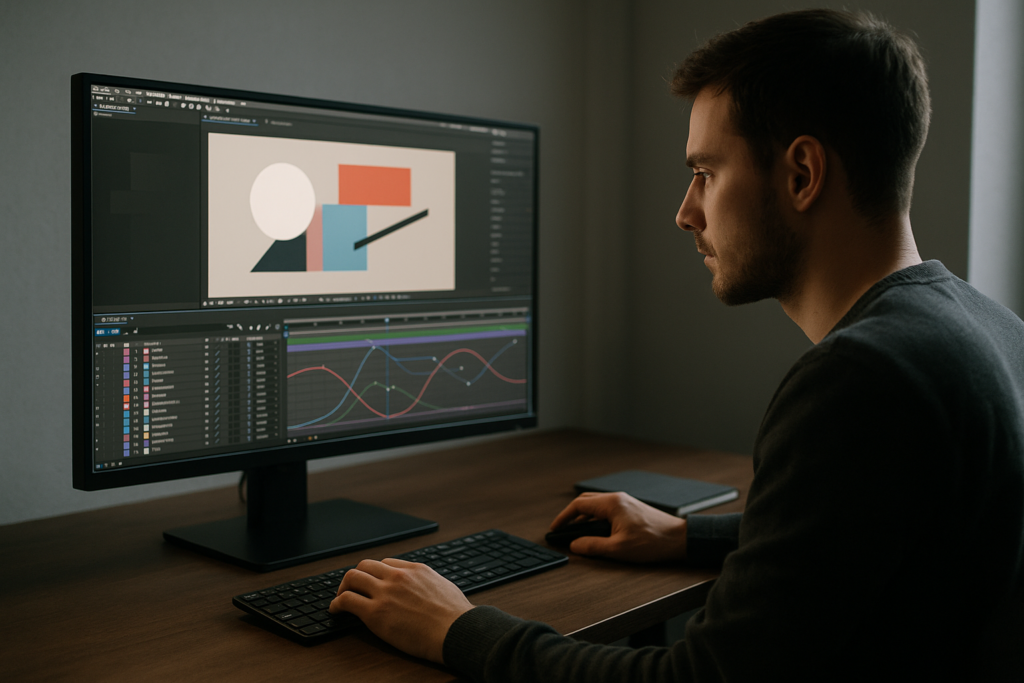
Motion design feels overwhelming when you start: keyframes, graphs, cameras, plugins, and endless tutorials. A clear, realistic motion design learning path keeps you focused, practicing the right skills for real projects in After Effects instead of getting lost in random experiments. This guide walks you from first keyframes to reliable client-ready workflows you can reuse and scale.Explore template access
Understanding what motion design really is
Motion design is the craft of giving graphic elements movement and timing to communicate ideas. In practice, that means animating text, shapes, UI, logos, and footage in tools like After Effects to tell clear visual stories.
For editors and creators, motion design sits between video editing and traditional animation. You are not drawing frame by frame; you are manipulating layers, keyframes, easing, and timing to create smooth, intentional movement.
Why motion design matters for modern editors
Strong motion design skills help you:
- Make titles, lower thirds, and overlays feel integrated instead of slapped on.
- Explain products, apps, and data with UI and infographic animation.
- Raise perceived production value for YouTube channels, ads, shorts, and corporate videos.
- Create reusable assets you can adapt across multiple edits and clients.
Who motion design is for
You do not need to be an illustrator or a traditional animator to follow a solid motion design learning path. It is ideal for:
- Video editors who want better titles, transitions, and graphics in their timelines.
- Content creators who need consistent intros, outros, and overlays.
- Designers who want to bring static layouts to life for presentations or product demos.
- Freelancers who want higher-value services than simple cutting and trimming.
The core skills to prioritize
To learn how to learn motion design efficiently, focus early on:
- Timing and spacing: how long actions take and how they accelerate or decelerate.
- Easing and arcs: avoiding robotic linear motion and harsh corners.
- Layer organization: naming, precomps, and clean timelines.
- Basic typography and layout: hierarchy, alignment, and whitespace.
Everything else—plugins, advanced effects, complex particles—sits on top of these fundamentals. A good motion design learning path makes sure you internalize these basics before chasing flashy techniques.
Designing a motion design learning path that fits editors
A useful motion design learning path is not just a playlist of random tutorials. It is a sequence of focused steps that move you from passive watching to building small, real-world animations in After Effects.
Break your learning into clear stages
- Stage 1 – Orientation: Learn the After Effects interface, timeline, keyframes, and basic effects. Rebuild a simple project, like a minimal lyric video similar to this type of lyric animation, to understand layers and text.
- Stage 2 – Core motion principles: Practice position, scale, rotation, opacity, and easing. Animate simple shapes, logos, or short text lines with clean timing.
- Stage 3 – Applied projects: Build short pieces: a logo reveal, a lower third, a YouTube intro, or a simple UI widget animation.
- Stage 4 – Systems and templates: Start reusing setups and exploring templates so your work becomes faster and more consistent.
Match your projects to your goals
Your motion design learning path changes slightly depending on where you work:
- YouTube creators: Focus on intros, lower thirds, and on-screen widgets. Recreate elements similar to a simple YouTube-style widget animation to practice data, icons, and timing.
- Commercial and product work: Emphasize UI, app, and card animations. Small dashboard or payment card motions, like a streamlined finance widget akin to a payment card style animation, teach you how to move flat designs with clarity.
- Music and lyric content: Short text-driven videos and animated lyrics train your rhythm and typographic timing.
Practice loops, not long timelines
Early on, focus on 3–8 second animations instead of full edits. For example:
- A looping loading indicator or pulsing icon.
- A short UI reveal sequence.
- A quick logo sting for an intro.
Short loops let you refine easing, overlap, and spacing without getting lost in minutes of footage.
Make templates part of your learning path
Studying finished projects is one of the fastest ways to learn how to learn motion design. Open a well-structured After Effects template and examine:
- How the designer organized precomps and layers.
- Which expressions or controllers they used.
- How they timed transitions between sections.
Browsing collections of motion projects, such as the variety of widgets and stylized edits on curated motion templates, gives you realistic targets and reference structures for your own path.
Common motion design mistakes that slow down learning
Most editors learning motion design struggle not because they lack talent, but because they pick up a few bad habits in After Effects that become hard to undo. Spotting these early keeps your motion design learning path clean.
Messy compositions and timelines
- No naming: Layers named “Shape Layer 23” and “Text 19” make revisions painful.
- No precomps: Everything lives in one main comp, so small changes break other sections.
- Random durations: Comps with inconsistent lengths and start times make timing adjustments confusing.
Fix it: Name layers by function (e.g., “Title_Main”, “BG_Solid”), group related elements in precomps, and keep comp durations intentional.
Overusing linear keyframes
Leaving every keyframe as linear makes movement stiff and cheap. Motion should almost always accelerate and decelerate.
- Result: Robotic motion, harsh starts and stops, and no sense of weight.
- Fix: Use the Graph Editor to apply smooth ease-in/out, adjust influence, and shape curves.
Ignoring motion blur and shutter settings
Motion blur adds realism when used correctly, but many beginners either forget it or overuse it:
- Blur turned off: Fast moves look unnaturally sharp.
- Blur too heavy: Details smear and feel messy.
Fix it: Enable motion blur for layers that move significantly and keep global shutter settings sensible. Preview at full speed to judge the effect.
Overloading projects with heavy effects and plugins
Stacking glows, blurs, and particle systems on multiple layers in one comp kills performance.
- Result: Slow previews, stuttering playback, and constant cache clearing.
- Fix: Pre-render heavy elements, use adjustment layers wisely, and rely on simpler graphic solutions when possible.
Bad typography and layout
Even with smooth movement, poor font choices and alignment ruin the result:
- Too many fonts on one screen.
- Misaligned text and icons.
- No visual hierarchy between title, subtitle, and metadata.
Fix it: Limit yourself to one or two fonts, align elements to a grid, and use scale, weight, and color to guide the eye.
Skipping planning and references
Jumping straight into keyframes without a simple storyboard or reference clip leads to wandering timelines that never feel finished.
- Result: Confusing pacing, inconsistent style, and constant reworking.
- Fix: Sketch 2–4 frames, grab a short reference animation, and define the duration before animating.
Cleaning up these issues makes every step of your motion design learning path more efficient and prepares you for real-world client revisions.
Choosing the right motion approach for each project
Once you understand the basics, how to learn motion design effectively becomes a question of choosing the right techniques for the content in front of you. A social reel, a YouTube explainer, and a corporate deck each need different levels of complexity.
Social reels and shorts
Goals: punchy, legible, and fast-moving, optimized for small screens.
- Use bold text, clear contrast, and quick transitions.
- Aim for 1–3 main animation ideas per reel, not 10 different tricks.
- Keep timelines short and modular so you can reuse sections as a series.
Ads and promos
Goals: clarity of the offer, product highlight, and brand-consistent motion.
- Use smooth transitions and controlled pacing so details can be read.
- Focus on product benefits with supportive motion, not distracting effects.
- Plan clear beats: hook, product view, key features, closing CTA.
YouTube and creator content
Goals: personality, clarity, and a recognizable visual system across episodes.
- Create a reusable pack of intros, lower thirds, subscribe reminders, and info panels.
- Keep color, type, and motion language consistent from video to video.
- Study how successful channels design motion for their on-screen graphics; platform resources like YouTube creator education can complement your motion learning with strategy and content planning.
Corporate and explainer videos
Goals: readability, professionalism, and structure.
- Favor clean, minimal motion over loud effects.
- Use subtle transitions, fades, and simple shapes to support voiceover or narration.
- Consider UI-style animations for products or dashboards to visualize data.
Where templates fit in your decisions
When deadlines are tight, prebuilt After Effects projects help you:
- Prototype styles quickly by swapping text, colors, and footage.
- Maintain consistent design across multiple videos or a full series.
- Reverse-engineer professional timing and layout choices to refine your motion design learning path.
For many editors, the most sustainable approach is a hybrid: build a core motion language yourself, then lean on an Unlimited After Effects Templates Subscription for specialized needs and variations when the schedule gets aggressive.Compare subscription options
Practical template based workflow for learning motion design
Templates are not just shortcuts; they are study material. Used correctly, they accelerate how you learn motion design and help you adopt professional habits from day one.
Check compatibility before you start
Before opening any project file, verify:
- After Effects version: Make sure the template supports your version or later. Opening newer projects in older versions can break expressions and effects.
- Frame rate (fps): Match the template fps to your main edit (24, 25, or 30). Mismatched fps causes stutter or timing drift when you export.
- Resolution and aspect ratio: Check if the project is set up for 1080×1920 (vertical), 1920×1080 (horizontal), or square formats.
When testing ideas for lyric-style or music visuals, for example, open a project similar in complexity to a stylized text animation like a lyrics-focused composition to see how an entire song segment is structured.
Study organization: comps, precomps, and naming
When you open a template, resist the urge to immediately change colors and text. First, map the structure:
- Look at the main render comp and identify its length, fps, and resolution.
- Open key precomps: titles, backgrounds, elements, and control layers.
- Note naming conventions: prefixes like “CTRL_”, “MAIN_”, or “BG_” show how the designer thinks.
Adopt similar naming and precomp patterns in your own projects so your motion design learning path reinforces clean habits.
Performance-friendly workflow
To avoid slowdowns while studying or customizing templates:
- Lower preview resolution (Half or Quarter) while adjusting timing.
- Set Work Area to short segments instead of the entire comp.
- Use proxies for heavy footage and pre-render effects-heavy elements.
- Turn off motion blur while you refine timing; enable it for final previews and renders.
Understand plugin dependencies
Many templates rely on third-party plugins (for glows, particles, or 3D text). When learning, you have two options:
- If you have the plugins, study how they are used and how settings affect the look.
- If you do not, try swapping them for native effects: use basic blurs, glows, and shape layers to approximate the original look.
Working around missing plugins teaches you problem-solving—crucial for real-world work where not every system or client supports the same stack.
Customization workflow checklist
Use this checklist each time you open a new template:
- 1. Collect assets: Gather logo versions, brand colors (hex values), fonts, copy, and footage.
- 2. Open controls: Find color controls and text controllers; test changing one universal color to see how it propagates.
- 3. Replace text logically: Start with key scenes (title cards, main hooks) before filling smaller labels.
- 4. Adjust timing: Use the Work Area to loop short sections as you fine-tune easing and overlaps.
- 5. Update typography: Swap fonts to match the brand, then tweak leading, tracking, and alignment.
- 6. Check safe areas: For vertical reels and shorts, make sure crucial text sits away from platform UI overlays.
Adapting templates to different formats
Part of how to learn motion design is learning how to repurpose work:
- Reels and shorts: Duplicate the comp, change resolution to vertical, and reframe elements. Scale background assets rather than text whenever possible.
- Ads and promos: Adjust durations for different placements (e.g., 6s bumper, 15s, 30s). Use markers to define key beats.
- Product and UI demos: Reuse widget or dashboard animations by swapping logos, texts, and metrics while maintaining the same motion system.
Small practice projects with templates
To make templates part of your motion design learning path instead of shortcuts only, try weekly exercises like:
- Rebuild a single scene from scratch without looking at the template, then compare structures.
- Combine two different template styles into one coherent sequence, forcing yourself to unify timing and typography.
- Take an interface-style animation similar to a simple map widget animation and turn it into a different theme (e.g., from maps to delivery tracking) while preserving the animation rhythm.
The more you dissect and rebuild, the faster you internalize patterns and move from “template user” to “motion designer who also uses templates strategically.”
Advanced motion design habits for long term growth
Once you are comfortable with basic keyframing and template customization, your motion design learning path should focus on consistency, reusability, and reliability across entire edits—skills clients and long-form creators depend on.
Build reusable animation systems
Instead of making each lower third or title from scratch, design small systems:
- Create a master title precomp with expressions or slider controls for size, position, and color.
- Use this master as a base for multiple text variations so motion remains consistent.
- Store commonly used transitions and text layouts in a dedicated project file you can import into new jobs.
Use styleframes and micro-boards
Before animating, create 3–5 static frames representing key beats of your piece:
- Opening frame (logo or hook text).
- Middle informational frame (stats, UI, or feature callouts).
- Closing frame (CTA or channel branding).
These styleframes anchor your typography, color, and layout decisions, which makes your animations feel like one system instead of a collection of tricks.
Maintain consistency across full edits
For multi-minute YouTube videos, series intros, or playlists:
- Define a limited motion vocabulary: 2–3 transition types, 1 style of lower third, 1 style of on-screen pop-up.
- Reuse ease curves: copy and paste keyframe velocity settings to keep motion feeling uniform.
- Use shared precomps and master controls for brand colors and fonts.
Export and render considerations
Efficient export workflows matter as much as good motion:
- Use the Render Queue or media encoder to create master renders in high-quality mezzanine codecs when needed.
- Pre-render heavy segments (particle scenes, complex glows) and re-import to keep the final project lightweight.
- Check audio sync and motion timing in your editing app after import; small frame rate mismatches can surface here.
Dynamic link and project weight
Linking After Effects comps directly into your editing software is tempting, but comes with trade-offs:
- Good for: last-minute text edits and minor layout tweaks without re-rendering.
- Risky for: long timelines with many linked comps, which can become unstable or slow.
For larger jobs, lock sections when approved, render them out, and replace dynamic links with flat files. This discipline keeps your systems reliable.
Quality control checklist before delivery
Use a checklist on every project to turn good habits into muscle memory:
- Check spelling, spacing, and alignment on all text layers.
- Verify that all motion blur, depth-of-field, and camera effects are intentional and not overdone.
- Scrub through at full speed to catch pops, gaps, or unfinished transitions.
- Test on different devices or sizes when possible to ensure readability.
These advanced practices make your motion design feel cohesive, scalable, and client-ready, whether you are working solo or as part of a team.
Search driven questions about learning motion design
As you define how to learn motion design for your own career, you will see similar questions appear in searches and forums. Addressing them briefly can clarify your path.
- How long does it take to learn motion design? Expect 3–6 months of consistent practice to feel comfortable with basic animations and templates, and 12+ months to feel confident handling client projects end to end.
- Do I need drawing skills to follow a motion design learning path? No. For After Effects based motion design, timing, layout, and design fundamentals matter more than illustration. You can work primarily with shapes, text, UI, and footage.
- Is After Effects enough, or do I need 3D? After Effects alone covers a huge range of work: lyric videos, UI animations, infographics, titles, and stylized edits. 3D tools are an optional specialization you can add later.
- Can I learn motion design as a video editor? Yes. Editors have strong storytelling instincts. Translating cuts and pacing into keyframes is a natural progression, especially if you start with titles, transitions, and on-screen graphics.
- How should I structure daily practice? Spend 30–60 minutes per day on focused exercises: recreate a 3–5 second reference animation, dissect a template, or build a new variation of a lower third or widget in After Effects.
- What is the best way to get feedback? Share short clips, not full edits: small loops, transitions, or title sequences. It is easier for other motion designers to give specific, actionable notes on these short examples.
Using common search questions as prompts for small, targeted exercises keeps your motion design learning path grounded in real-world challenges people actually face.
Putting your motion design learning path into action
By now you know that learning motion design is less about memorizing effects and more about building reliable habits: clean structure, thoughtful timing, and reusable systems in After Effects. A clear motion design learning path lets you focus your energy: short, focused projects, careful study of existing templates, and steady improvement in each new edit.
As you move forward, aim for three outcomes: smoother motion, faster workflows, and more consistent results across every video you touch. Combine deliberate practice with smart reuse of well-built projects and, if it fits your workflow, an Unlimited After Effects Templates Subscription to give you a steady supply of reference structures and ready-to-adapt designs. Over time, your library and skills will grow together, making each new piece easier and more polished than the last.
Conclusions
A focused motion design learning path turns After Effects from an overwhelming interface into a predictable, creative tool. Prioritize structure, timing, and small, reusable systems. Learn from real projects and templates, keep your timelines clean, and build habits you can rely on. Consistent practice and smart workflows will steadily raise the quality and speed of everything you deliver.
FAQ
What is the fastest way to learn motion design in After Effects?
Combine short daily exercises with dissecting existing project files. Recreate 3–5 second reference clips, study clean templates, and focus on timing and easing first.
How many hours per week should I practice motion design?
Aim for 5–10 focused hours weekly. Short, consistent sessions beat occasional marathons, especially when you work through specific mini projects instead of random experiments.
Should beginners use After Effects templates or build everything from scratch?
Use both. Templates help you see professional structure and timing, while building small elements from scratch develops your problem-solving and design judgment.
Do I need paid plugins to follow a motion design learning path?
No. You can learn core motion principles with native After Effects tools. Plugins are optional upgrades for speed or specific looks once your foundations are solid.
Is motion design a good skill for YouTube creators and editors?
Yes. Strong motion design improves titles, intros, overlays, and explainers, making channels look more professional and helping editors deliver higher-value work worldwide.