
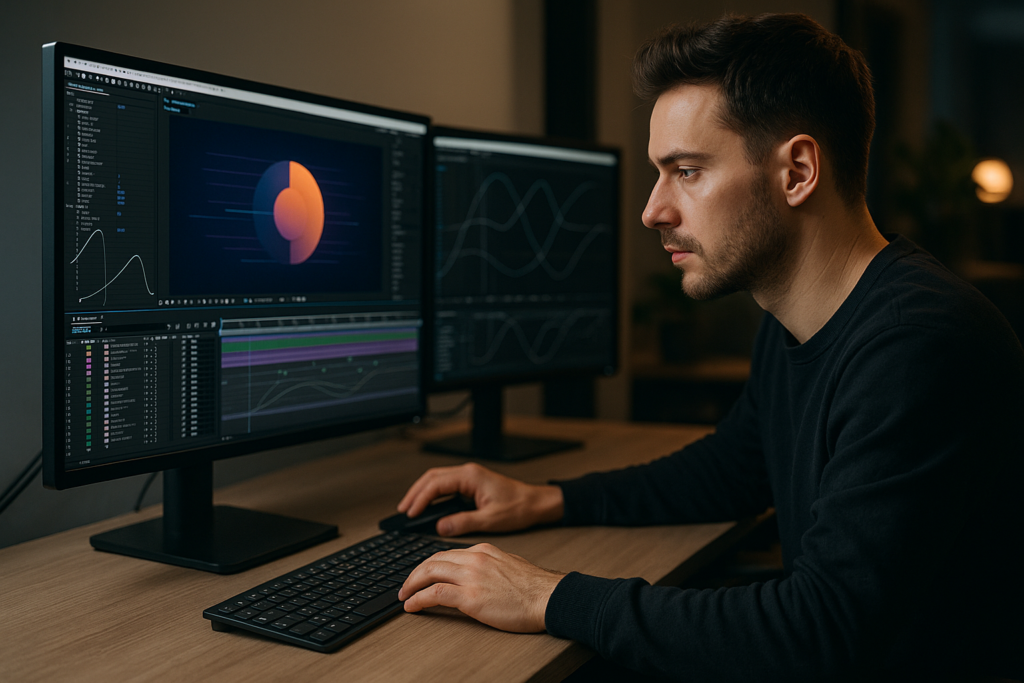
Professional motion design is less about flashy effects and more about consistent, deliberate decisions. When your animations feel intentional, clean, and on-brand, clients trust you and editors love working with your files. This guide breaks down how to make motion design more professional with a workflow you can actually use in After Effects every day. Explore pro-ready templates
Understanding What Makes Motion Design Professional
What professional motion design really is
Professional motion design is about control, clarity, and communication. Instead of random movement, every animation choice supports a message, story, or brand. It feels intentional: timing, spacing, typography, color, and composition all work together without calling attention to the tools behind them.
Why it matters for editors and creators
If you work in After Effects for clients, agencies, or your own brand, professional motion design directly affects:
- Perceived value – Smooth, confident animation makes content look premium even with simple assets.
- Editability – Clean comps and structure save hours when clients request revisions.
- Consistency – Professional work keeps a unified style across whole campaigns, not just individual shots.
Who this is for
This approach is aimed at:
- Editors who need motion graphics that drop easily into Premiere timelines.
- Motion designers building full sequences, titles, widgets, and UI animations.
- Content creators making reels, shorts, explainers, or YouTube intros and wanting them to look studio-grade.
From effects-first to workflow-first
Beginners often focus on new plugins or trendy presets. Professional motion design starts from workflow: smart project setup, controlled animation curves, consistent typography, and reusable systems. Effects become finishing touches, not the foundation. The rest of this guide walks through that workflow so your work looks intentional and reliable, not experimental and fragile.
Building a Professional Motion Design Workflow
What a professional motion design workflow looks like
A professional motion design workflow is a repeatable process you can rely on across different projects and clients. It connects planning, design, animation, and delivery into a single, predictable pipeline instead of a series of improvisations.
Core stages of a professional motion design workflow
- Brief and goals – Who is this for? Where will it live? What does success look like: clicks, watch time, clarity?
- References and style – Collect visual and motion references, moodboards, or examples from award sites and brand libraries.
- Structure and timing – Define duration, beats, scenes, and key message moments before animating.
- Design systems – Lock in typography, color, layout, and motion rules (ease, speed, overshoot).
- Production and templates – Build or adapt modular comps, transitions, and widgets that you can reuse.
- Review and polish – Fine-tune timing, easing, motion blur, and spacing; check exports in real-world platforms.
Matching workflow to project types
Your professional motion design workflow should adapt to the content type:
- Social and widgets – Fast-paced, legible, with strong hierarchy and clear calls to action.
- Lyrics and music videos – Beat-accurate timing, expressive type motion, texture and rhythm.
- UI and product visuals – Subtle, realistic easing; clarity over spectacle.
- Brand and campaign content – Cohesive style across multiple deliverables with shared systems.
Using templates within a pro workflow
Professionals use templates not to skip thinking, but to standardize quality and save repetitive setup time. For example, when you regularly create animated widgets or overlays, starting from a proven project like the YouTube widget template lets you focus on content and timing instead of rebuilding sliders, masks, and keyframes on every job.
Scaling your workflow
Once you define a professional motion design workflow, scaling becomes easier: assistants can help, other editors can open your files without guessing what is happening, and you can reuse systems across deliverables like lyric sequences or product widgets instead of starting from zero each time.
Common Mistakes That Keep Motion Design From Looking Professional
Messy project structure
One of the fastest ways to make motion design feel amateur is a chaotic project panel. When comps have random names and assets live everywhere, changes become slow and errors multiply.
- Use clear folders: 01_INPUT, 02_PRECOMPS, 03_MAIN, 04_RENDERS.
- Name comps descriptively: MAIN_Intro_Logo_1080p instead of Comp 12.
- Delete unused solids, precomps, and layers before delivery.
Poor timing and spacing
Even with good design, bad timing makes motion look cheap. Typical issues include:
- Animations starting and stopping too abruptly.
- Everything moving at the same speed.
- No hierarchy in timing: primary elements and secondary accents feel identical.
Fix this by working in blocks: define key beats, then offset layers by a few frames to create depth and rhythm.
Ignoring the Graph Editor and easing
Linear motion screams beginner. Common mistakes:
- No easing applied, or relying only on default Easy Ease.
- Overdoing bounce and overshoot, making UI look rubbery.
- Uneven curves causing jitter or unnatural stops.
Spend time in the Graph Editor to craft curves: slow out of static states, accelerate into motion, and soften deceleration.
Overusing motion blur and effects
Motion blur and glow can help, but when everything is blurry and glowing, nothing feels sharp or intentional. Watch for:
- Motion blur on small UI micro-movements where it just muddies details.
- Multiple glows and blurs stacked without reason.
- Color corrections that crush contrast or brand colors.
Heavy plugins and fragile setups
Depending on niche plugins for core animation makes projects hard to share and update. This leads to:
- Missing plugins on other machines.
- Long render times and crashes.
- Difficulty customizing animations later.
Whenever possible, build key mechanics with native tools, then enhance with plugins only when necessary.
No clear visual hierarchy
Without hierarchy, everything competes for attention. Mistakes include:
- Same scale and weight for all text.
- Too many colors and typefaces.
- Background elements animated as strongly as key information.
Establish lead elements (titles, key UI states), support elements (subtitles, icons), and background elements (patterns, textures). Animate them with different intensity and timing.
Skipping quality control
Professionals review:
- Edges for flicker and aliasing.
- Type for spelling, kerning, and readability on mobile.
- Exports on actual platforms (stories, feeds, YouTube) to check compression.
Building a habit of structured QC is one of the simplest ways to make motion design look more professional quickly.
Choosing the Right Approach for Each Motion Design Project
Start from the platform and use-case
A professional motion design workflow always starts with where the piece will live. Different platforms reward different pacing, framing, and complexity.
- Social reels and shorts – Vertical, fast, bold. Use tight framing, large type, and clear hooks in the first second.
- Paid ads – Platform-safe type and colors, strong CTAs, clean hierarchy, and strict duration control.
- YouTube and long form – Branded intros, lower thirds, and reusable info panels that do not distract from content.
- Cinematic and title sequences – Slower pacing, more nuanced easing, and careful sound sync.
- Corporate and explainers – Clarity and legibility over visual experiments, with brand guidelines driving choices.
Deciding when to build from scratch vs. using templates
Use a custom build when:
- You are defining a new visual identity or motion language.
- The client needs something highly specific and unique.
- The animation logic is simple and one-off.
Use templates when:
- You need consistency across many deliverables (campaign graphics, series intros, recurring widgets).
- Turnaround time is tight but quality still matters.
- You want to stay focused on story and message instead of rigging every element from zero.
Adding inspiration and benchmarks
Professional designers often collect references from curated sites. Studying awarded sites and motion examples on Awwwards helps you understand pacing, transitions, and interactions that feel current and polished, so your work aligns with modern expectations.
Practical example: UI widget animation
Imagine you are building a series of UI-style animations for a fintech client. You could:
- Define a motion system where all cards slide with similar easing and timing.
- Use a structured starting point like the Stripe-inspired widget animation as reference for spacing and hierarchy.
- Create variations where button states, balances, and charts change, while core motion feels consistent.
Practical example: music-driven lyrics edit
For a lyric video, you want beat-perfect sync and expressive typography. Starting from a dedicated project such as a lyric-style After Effects project gives you time-tested timing structures, so you can focus on type choices, color, and narrative motion rather than redoing every sync rig.
Balancing speed and originality
The goal of a professional motion design workflow is to deliver reliable quality fast, not to reinvent every keyframe. Combining reusable structures with custom details is usually the sweet spot for both studios and solo creators.See motion workflow plans
Practical Template-Based Workflow Guide for After Effects
Project setup and compatibility
Before you touch any keyframes, confirm technical settings. A professional template-based workflow starts by matching:
- After Effects version – Check which version a project requires and open it in a compatible environment to avoid broken expressions.
- Frame rate – Align the template FPS with your final delivery (23.976, 25, 30, 60). Mixing frame rates later causes stutters.
- Resolution and aspect ratio – Set up compositions specifically for 9:16, 1:1, or 16:9 instead of scaling later.
If you know your primary output will be 9:16 reels, adjust the master comp early to avoid late-stage cropping.
Organizing comps and precomps
A professional motion design workflow relies on clean hierarchy:
- Create master comps for each deliverable (e.g., MAIN_Reel_15s, MAIN_YT_Intro).
- Use precomps for reusable elements: titles, lower thirds, transitions, background loops.
- Label layers with colors according to type: text, control layers, footage, UI elements.
Study structured projects like the map widget animation to see how complex widgets are broken into logical precomps.
Keyframe organization and naming
Professional motion design is readable in the timeline. Some habits:
- Use nulls or controllers for global movement instead of keyframing every layer separately.
- Group related keyframes in time by using markers to label beats or sections.
- Name controllers clearly: CTRL_Color, CTRL_Typography, CTRL_Timing.
This not only speeds up changes but also allows editors to adjust motion without digging through every layer.
Performance and preview tips
Templates can be heavy. To keep your workflow responsive:
- Turn on region of interest and solo key layers when working on specific parts.
- Drop preview resolution to half or quarter during layout and timing passes.
- Use proxies or reduced-resolution footage for large video backgrounds.
- Regularly purge cache and close unused comps to keep memory free.
For longer sequences, pre-render complex background loops and re-import them as video to lighten the live timeline.
Managing plugin dependencies
Many advanced templates rely on popular plugins, but a professional setup anticipates this:
- Check the readme or notes for required plugins and minimum versions.
- Identify critical vs. cosmetic plugin usage (core animation vs. glows or textures).
- Prepare fallbacks: if a plugin is missing, can you replace it with native blur, glow, or shape layers?
When sharing project files, include a note listing required plugins. This small step instantly feels more professional to clients and collaborators.
Customization workflow for brand alignment
Instead of editing dozens of layers manually, use a top-down approach:
- Locate main control comps or layers (often named Controls, Styles, or Global).
- Set brand colors on shape layers, gradients, and effects using swatches or expression-linked controls.
- Define typography once (font family, weight, tracking) and reuse those text styles across all comps.
- Adjust timing globally using master controllers or by shifting key sections.
When you work on a recurring content series, building a style-driven setup like the one used in modular widgets such as smart TV-style overlays makes future episodes much faster.
Timing, transitions, and rhythm checklist
Use this quick checklist when adapting templates:
- Does each section have a clear in, hold, and out?
- Are transitions paced logically with the music or voiceover?
- Do elements overlap enough to feel continuous, not jumpy?
- Is the viewer always looking where you want them to look?
Refine timing first, then add secondary details like accents and particle hits afterward.
Use cases and template strategies
Reels and shorts: Use bold, fast templates with large type and punchy entrances. Keep main messages on screen at least 1.5–2 seconds for readability.
Product promos: Highlight key features with clean UI or 3D-ish layouts. A structure similar to a modern UI widget project or an app-focused bank animation works well across many industries.
Cinematic edits: Use subtler transitions, camera moves, and grain. Focus on easing, parallax, and depth rather than flashy wipes.
Lyrics and music: Prioritize beat sync and type expression. Use nested comps for verses and hooks so you can tweak rhythm per section.
Final pre-delivery checklist
Before exporting, run through:
- All text spelled correctly and aligned to safe areas.
- Brand colors and logos consistent across shots.
- No stray layers, shy layers incorrectly hidden, or disabled effects by mistake.
- Audio and motion in sync at the final frame rate.
Following this structured approach turns templates from shortcuts into reliable building blocks of a truly professional motion design workflow.
Advanced Techniques for Long Term Workflow Optimization
Designing reusable animation systems
Professionals think in systems, not one-off effects. Instead of custom easing on each layer, define motion rules:
- Consistent entrance types for titles, buttons, and icons.
- Standard easing curves for UI slides and fades.
- Reusable nulls or controllers for camera and parallax moves.
Use these systems across multiple videos and series to instantly make everything feel more cohesive.
Maintaining visual and motion consistency
Across a full edit or campaign, keep a simple style guide:
- Primary and secondary type styles.
- Palette with specific usage (backgrounds, accents, alerts).
- Motion patterns: distance, duration ranges, and typical offsets.
This can be as simple as a reference comp in your project where you store key styles, transitions, and easing curves.
Using styleframes and motion tests
Before building full sequences, create a few keyframes or short tests that capture the intended look and feel. This is especially useful for complex edits like UI dashboards or music-driven content such as a stylized piece in the spirit of a pop-driven visualizer. Once approved, apply those principles everywhere.
Modular transitions and scenes
Set up transitions as independent precomps that you can drop between scenes:
- Simple wipes, pushes, and fades that respond to control layers.
- Branded stings that reveal logos or section titles.
- Category or chapter openers that repeat across episodes.
Keep these modular elements stored in a dedicated folder so you can reuse them in future projects.
Export and delivery considerations
A professional motion design workflow includes consistent export routines:
- Match codec to platform: lightweight H.264 for social proofs, higher bitrate or ProRes for broadcast and handoff.
- Include alpha channels only when needed to reduce file size.
- Use naming conventions like ProjectName_Platform_Version to track revisions.
Check your exports against platform specs to avoid re-rendering for issues like incorrect length, bitrate, or dimension.
Render queue basics and automation
Instead of rendering one by one, set up batches:
- Queue all final comps with consistent output modules.
- Use templates in the Render Queue for identical settings.
- Consider background rendering tools or render farms for heavy sequences.
For recurring content, saving output module presets can cut a surprising amount of time from every project.
Dynamic link and project weight
Dynamic Link between After Effects and editing software is powerful but can become fragile:
- Use it for titles and overlays that may need rapid changes.
- Avoid stacking multiple heavy comps with Dynamic Link inside complex edits.
- Once locked, bake heavy sections to video to keep timelines responsive.
Keep your After Effects projects lightweight by periodically cleaning unused assets, collecting files, and archiving finished versions.
Building a library of trusted components
Over time, collect your favorite systems, transitions, and widgets into a personal library. This can include:
- Callout animations.
- Metrics displays inspired by dashboard-style layouts like a crypto metrics widget.
- Lower thirds, subtitles, and title cards.
This library, combined with reliable templates, becomes the backbone of your professional motion design workflow and lets you scale output without losing quality.
Search Driven Motion Design Questions and Quick Answers
How to make motion design more professional with limited experience
Focus on timing, spacing, and clean structure before worrying about complex effects. Use well-built templates to learn how pros organize comps and controllers, then gradually customize and adapt them for your own projects.
What is a professional motion design workflow for YouTube intros
Define a short 3–7 second structure: logo or channel name, supporting text, and a quick accent animation. Lock in fonts and colors, then reuse the same project for all episodes by swapping titles and background footage.
How can editors integrate motion design without leaving their NLE
Build or adapt motion graphics as dynamic templates in After Effects, then expose only the key controls editors need. They can change text, colors, and some timing directly in the NLE while the complex animation remains safely inside the original project.
Best way to keep templates consistent across reels and stories
Start from a master 9:16 project with defined type and color styles. Create multiple scene variations inside that project (hooks, overlays, swipe-ups) and reuse them across all reels instead of building new layouts every time.
How to avoid heavy, laggy After Effects projects
Limit precomp nesting depth, clean unused layers, and pre-render especially complex background loops. Use lower resolution previews, and be careful with layer styles, deep blurs, and 3D lights, which can become expensive quickly.
How do templates help worldwide teams stay consistent
Shared, well-documented templates with clear controls make it possible for editors and designers in different locations to produce content that looks like it came from the same studio, even when they work in different time zones or on different machines.
Bringing It All Together For Professional Motion Design
Recap of key principles
Professional motion design is built on clear structure, intentional timing, and consistent visual decisions. Your workflow matters as much as your creativity: organized comps, predictable easing, and reusable systems allow you to deliver confidently under pressure.
From scattered experiments to reliable systems
Instead of treating each project as a new experiment, treat them as variations on a reliable base: shared styles, recurring transitions, and repeatable widgets that work across platforms and campaigns. This approach keeps the bar high even as volume increases.
Next steps for your workflow
Define your own motion rules, study well-structured projects, and gradually replace ad-hoc setups with stable, editable templates. Over time you will spend less effort fixing problems and more time refining details that truly make motion design feel polished and professional.
Scaling with professional resources
When your pipeline is based on proven building blocks and a consistent professional motion design workflow, you can handle more clients, more formats, and more revisions without burning out or sacrificing quality.
Using Unlimited After Effects Templates To Stay Consistent
Why unlimited access changes your day to day work
Having an Unlimited After Effects Templates Subscription means you are never starting from a blank comp when you do not want to. Instead of rebuilding the same kinds of animations for each campaign, you can:
- Quickly test multiple visual directions before committing.
- Maintain consistent animation systems across clients and platforms.
- Free up time for story, concept, and sound design instead of repetitive setup.
Practical example: widget heavy edits
If your work involves recurring UI or data-driven visuals, mixing and matching projects like a battery-style widget with other data cards gives you a library of ready-made building blocks. You can adapt them for dashboards, product highlights, or explainer segments without re-rigging everything from scratch.
Practical example: content series at scale
For recurring weekly videos or social posts, starting from a series of prepared projects – for example, a lyric-style comp like a text-driven music layout plus a few branded openers and transitions – lets you ship content reliably week after week. Your viewers see stable branding; you see shorter production time and fewer last-minute problems.
Keeping your workflow sustainable
As your project count grows, so does the risk of burnout and disorganized files. Leaning on a curated library and subscription approach lets you stay focused on creative decision-making rather than rebuilding common structures. That is what allows a professional motion design workflow to scale across clients, collaborators, and worldwide projects while keeping quality and consistency high.
Conclusions
Professional motion design comes from deliberate systems: organized projects, intentional timing, and reusable structures. When After Effects becomes predictable and your templates are reliable, you can focus on creative decisions and client goals instead of fighting the timeline. Keep refining your workflow, and every project you deliver will feel more consistent, polished, and confidently professional.
FAQ
How can I make my motion design look more professional quickly?
Clean up your project structure, focus on easing in the Graph Editor, and reduce unnecessary effects. Small improvements in timing and hierarchy go a long way.
What is a professional motion design workflow in After Effects?
It is a repeatable process from brief to export: define goals, set styles, organize comps, animate with clear rules, review, then export with consistent settings.
Do I need plugins to achieve professional motion design?
No. Plugins help, but professional results mostly come from timing, spacing, and structure using native tools. Add plugins later for specific looks or efficiencies.
How do templates fit into a professional workflow?
Templates act as tested building blocks. Pros use them to standardize quality and speed, then customize timing, color, and typography to match each project.
How can I keep After Effects projects lighter and faster?
Limit nested precomps, avoid unnecessary 3D and heavy blurs, pre render complex sections, manage cache, and use lower resolution previews during layout passes.
How do I ensure consistency across a whole video series?
Use the same project or template as a base, lock in type and color styles, reuse transitions, and maintain a simple motion guide with standard easing and durations.