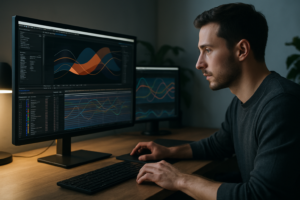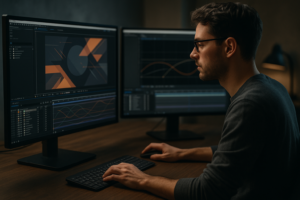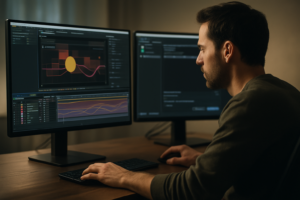

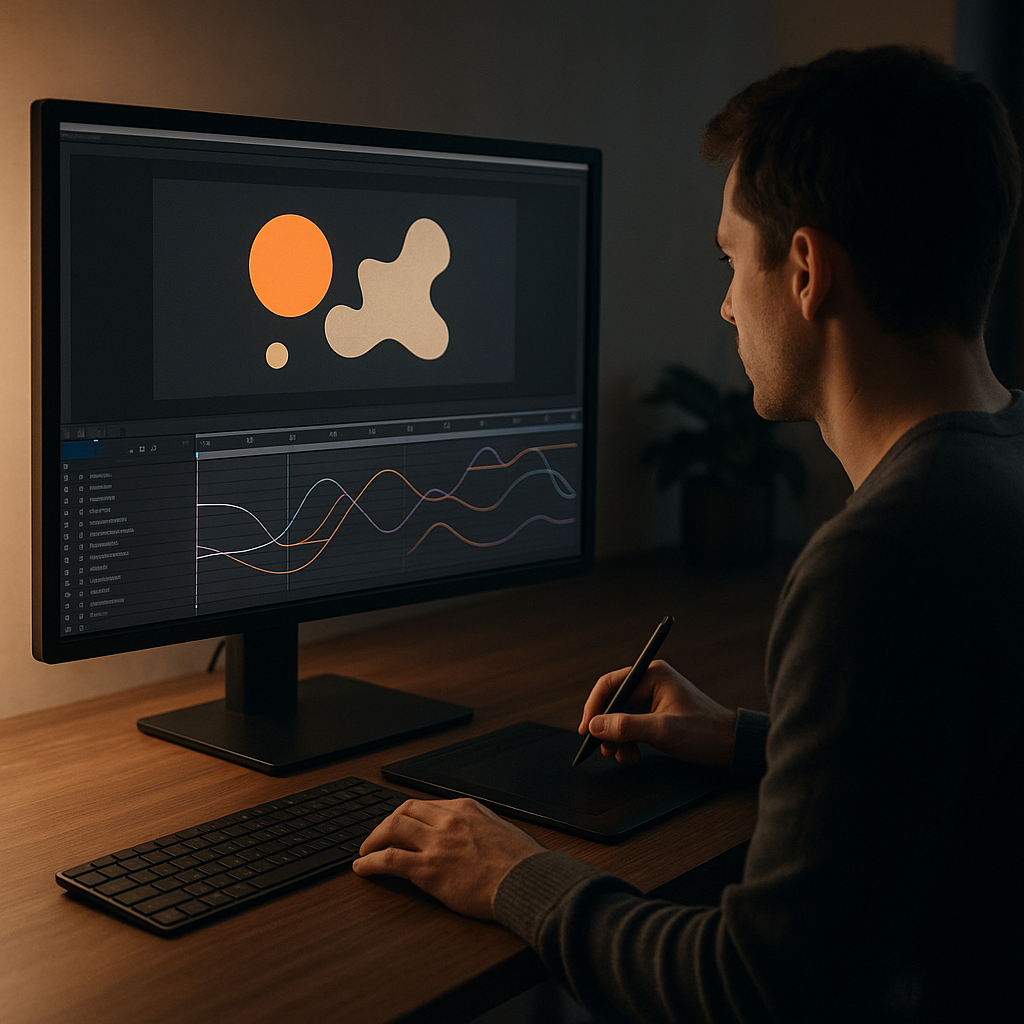
Motion design project files give editors and designers a huge head start in Adobe After Effects. Used correctly, they speed up delivery, keep quality consistent, and free you to focus on creative decisions instead of rebuilding the same animations from scratch.Explore template plans
Understanding Motion Design Project Files
What motion design project files are
Motion design project files are fully built After Effects projects that already contain compositions, keyframes, assets, and animation systems. Instead of designing an animation from zero, you start from a working scene and customize it: text, colors, timing, or layout.
For editors and motion designers, these files are essentially reusable building blocks. They can be simple logo reveals or full social ad layouts with transitions, overlays, and typography already dialed in.
Why they matter for After Effects users
Creating polished motion from scratch is time-consuming. Clean easing, secondary motion, and layout all take iterations. Motion design project files let you:
- Skip repetitive setup work and jump straight into creative decisions.
- Maintain consistent style across a campaign or entire channel.
- Deliver more versions and formats without burning time.
- Use proven animation setups instead of guessing what will look good.
Who benefits most
These files are especially useful for:
- Editors who mainly cut in Premiere or another NLE but need quick, good-looking motion graphics inside After Effects.
- Motion designers who handle recurring deliverables like social packages, lyric videos, or widget-style overlays.
- Agencies and freelancers who must keep brand consistency across many timelines and formats.
- Content creators who want professional motion without spending years mastering every detail of animation.
Basics of how they work
Most motion design project files open as a normal .aep file. You will usually find:
- A main render composition.
- Precomps for titles, overlays, or UI elements.
- Control layers (often with color and timing controls).
- Placeholder layers for media like video, logos, or photos.
Once you understand the structure, you can adapt these projects to your own assets and workflows instead of reinventing the wheel each time.
After Effects Project Files Download Types and Use Cases
What “after effects project files download” usually means
When you see “after effects project files download,” it generally refers to ready-made .aep projects you can import or open directly. These downloads can be tiny utility files or complete packages for a full piece of content.
Main types of downloadable project files
- Widget and overlay projects – HUDs, UI cards, social widgets, and dashboards that sit on top of footage. Examples include finance or app-style interface widgets.
- Lyric and music-based animations – Typographic animations synced to tracks, perfect for music videos or social clips.
- Brand and product promos – Scenes focusing on devices, apps, or physical products, built with camera moves and transitions.
- Seasonal or thematic templates – Visuals tailored for events like holidays or special campaigns.
On Olaf Motion, you will find specific widgets and lyric-style projects such as modern financial UI in the digital banking animation project or festive visuals like the Christmas tree animation project, which can be repurposed for different campaigns.
Matching downloads to your intent
Before you grab an After Effects project files download, clarify your purpose:
- Social content and shorts – Look for vertical-friendly layouts, bold typography, and easy text replacement. A UI-style overlay like the video platform widget template can be ideal for commentary or review content.
- Music and lyric videos – Choose projects built around rhythm and text, such as energetic lyric animations similar to the colorful lyric template.
- Data, finance, and dashboards – Download project files that focus on cards, graphs, and status panels, using widgets like the crypto widget animation.
- Utility motion for editors – Quick elements like battery or system indicators, such as the battery widget project, can fill gaps in edits without full custom design.
Comparing packs, single templates, and subscriptions
When you search for “after effects project files download,” you will usually encounter:
- Single templates – One project solving one task (for example, a single widget or intro).
- Collections or packs – Multiple related scenes or widgets that share a style.
- Template subscriptions – Ongoing access to a full library, which is ideal if you produce recurring content and need multiple looks for different clients or channels.
Choosing between these options depends on whether you are solving a one-off need or building a long-term library for your motion design pipeline.
Common Motion Design Workflow Mistakes in After Effects
Messy compositions and naming
One of the biggest pain points in motion design project files is disorganized timelines. Editors often drop clips and adjustment layers everywhere, leaving future revisions almost impossible.
- Name key comps clearly (MAIN, TEXT_01, BACKGROUND, CONTROL).
- Group layers by function using color labels.
- Avoid stacking dozens of layers in one comp when precomps would be clearer.
Ignoring timing and pacing
Beginners often rely only on default linear keyframes. This leads to stiff moves, poor sync with music, and awkward transitions.
- Use the graph editor for smoother easing and speed ramps.
- Align beats of motion to the audio where possible.
- Check pacing on both 1x and 2x playback to spot stiff moves.
Overusing or misusing motion blur
Turning on motion blur for every layer can slow previews and make things muddy.
- Enable motion blur only where fast movement needs it.
- Balance shutter angle so the scene does not smear.
- Use test renders to judge how blur looks at final frame rate.
Heavy plugins without a plan
Stacking third-party plugins inside motion design project files can cause:
- Sluggish previews on laptops.
- Missing effect warnings when collaborators do not own the same plugins.
- Render issues on shared machines or farms.
Keep a checklist:
- Minimize plugin use to what really adds value.
- Document which plugins are required for each project file.
- Whenever possible, use native effects as backups.
Poor precomp strategy
Too few precomps makes the main comp unreadable; too many makes navigation slow.
- Precomp repeated systems (typography modules, UI cards, transitions).
- Keep global controls (colors, brand settings) as top-level adjustment layers.
- Avoid nesting precomps deeply unless necessary for effects.
No performance awareness
Ignoring performance leads to painful playback and missed deadlines.
- Work at half or quarter resolution for layout and timing.
- Use region of interest to focus previews.
- Purge cache only when needed, not constantly.
Lack of handoff readiness
If you work with clients, assistants, or other editors, your motion design project files must be readable.
- Use comment layers or guide layers to explain controls.
- Lock layers that should not be edited.
- Keep assets in a single, clearly named folder structure.
Addressing these mistakes early makes any downloaded or custom project file much easier to reuse and scale across multiple jobs.
Choosing the Right Motion Design Project Files for Each Edit
Start with the final output
Before you pick any motion design project files, define where your video will live and what role motion plays:
- Social reels and shorts – Vertical formats, fast cuts, bold graphics.
- YouTube videos – Lower thirds, HUD overlays, and chapter graphics.
- Paid ads – Strong hierarchy, clear CTAs, legible on mobile.
- Cinematic pieces – Subtle motion, clean typography, film-like pacing.
- Corporate explainers – Clarity, brand alignment, and readable data visuals.
Match file complexity to your timeline
If a client needs a spot tomorrow, a complex, experimental template may not be realistic. Instead:
- Pick modular templates where you can swap text and media quickly.
- Look for clear control layers so you can change colors and timing fast.
- Avoid heavy simulations or 3D setups unless they are crucial.
Consider your team and toolset
Think about who will open the project after you:
- If editors do minor tweaks, choose cleaner, more documented project files.
- If a junior motion designer must localize text, avoid overly complex expressions that are hard to debug.
When templates are the smarter choice
Building everything from scratch is rewarding, but not always efficient. Motion design project files or an Unlimited After Effects Templates Subscription can be the better call when:
- You run a recurring show or channel that needs new episodes weekly.
- You handle multiple brands and need distinct yet consistent visual systems.
- You want a library of widgets (maps, chats, UI cards) ready to drop into edits.
Integrating templates into your broader workflow
Use the official Adobe After Effects help resources to stay aligned with best practices as you integrate templates into pipelines involving other tools or teams. This keeps your projects stable whether you are handing them to another editor, moving them into a finishing suite, or archiving them for reuse later.
Practical scenario breakdowns
- Social ad campaign – Choose a project file with multiple scenes (intro, product focus, price card, CTA). Keep typography large and mobile-first.
- YouTube tech review – Use clean widgets to show specs or comparisons. For example, a UI card set similar to the map-style overlay project can anchor location or stat callouts.
- Music-related content – A lyric or waveform-based template is ideal for shorts and teasers, especially for worldwide releases where quick localization matters.
By mapping output, timeline, and team capabilities, you can choose motion design project files that feel like part of your own design system instead of one-off experiments.Compare subscription options
Practical Workflow Guide for Working With Templates
Prepare your After Effects environment
Before importing any motion design project files, confirm basic settings:
- Version compatibility – Check the minimum After Effects version the template supports. Opening a newer project in an older version can break expressions or effects.
- Project settings – Verify frame rate (23.976, 24, 25, 30, etc.) and resolution match your master sequence. Changing these mid-project can cause timing drift.
- Color settings – Align color space and bit depth with your delivery (especially if you hand off to grading later).
Organize before customizing
When you open a new project file:
- Locate the main “Render” or “Final” comp.
- Find folders like “Edit Here,” “Controls,” or “Assets.”
- Bookmark key comps with layer labels and stars so you can return quickly.
Keyframe organization and precomps
Clean motion design project files rely on understandable keyframes:
- Use precomps for repeated blocks like titles, UI cards, and logo reveals.
- Keep timing-sensitive elements (such as music-synced text) in their own precomps.
- Use markers to indicate beats, section changes, or client notes.
When editing existing animations, avoid randomly deleting keyframes. Instead, scale timing via the keyframe stretch tool, or adjust speed using the graph editor so the motion stays smooth.
Performance tips for heavy templates
Some After Effects project files use particle systems, glows, and complex blurs. Keep them manageable:
- Preview at half or quarter resolution for layout changes.
- Solo only the layers or precomps you are adjusting.
- Turn off heavy effects while blocking out timing, then re-enable before final checks.
- Cache preview sections you are reviewing repeatedly.
Handling plugin dependencies
When templates require third-party plugins, document them immediately:
- Make a simple text layer listing required plugins and versions.
- Check if the project includes fallback precomps using native effects.
- If you expect collaborators to open the file, plan a plugin-free version where possible.
If a plugin is not available on a particular machine, consider baking certain layers into high-quality image sequences or ProRes clips from another system.
Customization workflow: from brand kit to final render
Use this checklist when customizing any motion design project file:
- 1. Drop in brand assets – Logos, product shots, UI screens, or footage, replacing placeholders.
- 2. Set global colors – Use control layers or adjustment layers to define brand colors once instead of recoloring each element manually.
- 3. Update typography – Change fonts to match brand guidelines and adjust tracking/leading for legibility in your target resolution.
- 4. Adjust timing – Align transitions and reveals with music hits or VO phrases. Use comp markers for key beats.
- 5. Polish easing – Fine-tune curves in the graph editor so animations feel intentional rather than default.
- 6. Run a motion safety pass – Check for flicker, excessive blur, or elements that move too quickly on small screens.
Use cases and practical scenarios
- Reels and shorts – Use quick-cut templates where each precomp is a self-contained scene. This lets you swap segments rapidly to test which structure performs better.
- Ads and product promos – Build one master ad using a project file, then duplicate the comp and adjust durations for 6, 15, and 30-second versions.
- Cinematic edits – Incorporate subtle UI, text, or texture overlays from motion design project files, keeping them secondary to footage.
Real-world example workflow
Imagine you need a stylized widget overlay series for a gaming or app-focused video. You could start from a prebuilt HUD-style project similar to the gaming widget animation project and adapt colors, icons, and timing to your own brand. Once the first piece is approved, duplicate the comp and adjust content only, keeping animation identical. This turns your template into a reusable system instead of a one-off file.
Advanced Template Use and Long-Term Workflow Optimization
Think in systems, not one-offs
Once you are comfortable with motion design project files, start thinking in terms of reusable systems:
- Create a “Core Library” project that collects your favorite overlays, transitions, and widgets.
- Standardize how control layers are named and colored across all templates.
- Develop a predictable folder structure for assets so anyone on your team can jump in.
Maintain consistency across a whole series
For shows, playlists, or campaign groups, viewers should recognize your motion instantly.
- Define a shared style guide: easing style, transition types, and text behavior.
- Use a single master color controller that you can copy between project files.
- Reuse lower thirds and info cards from one central template for every episode.
Styleframes and preview passes
Before committing to long sequences, build short styleframes or 3–5 second motion tests:
- Render small sections to send for client approval.
- Test multiple type treatments or color variants quickly.
- Use comments and markers inside templates to track feedback.
Modular transitions and reusable scenes
Many After Effects project files include transitions or mini-scenes. Turn these into re-usable modules:
- Isolate transitions in their own precomps with clear in/out handles.
- Use guide layers to mark safe zones for footage or text.
- Tag modules with names like “Intro_SlideIn” or “Outro_GlowFade” so editors can pick them fast.
Quality control and review process
To keep high standards, build a repeatable QC checklist:
- Check spelling and alignment on every text layer.
- Verify all temporary assets or watermarked placeholders have been replaced.
- Scan for unwanted layers or guides left visible in final renders.
- Play back on multiple devices when possible (desktop and phone).
Export and render strategy
Efficient rendering is part of a good motion design workflow:
- Use Adobe Media Encoder for flexible queueing and background renders.
- Choose mezzanine codecs (like visually lossless intraframe formats) for handoff to editing or grading.
- Keep export presets for common platforms (YouTube, social, broadcast) to avoid mistakes.
Dynamic link and project weight
It is tempting to keep everything live with dynamic links, but this can slow systems and complicate archiving.
- Use dynamic link for shots that truly need frequent iteration.
- For locked sections, render intermediates to reduce stress on your machine.
- Clean unused comps and assets from project files before archiving.
Archiving and future-proofing
To make sure your motion design project files remain usable in the future:
- Collect files so all footage, fonts, and assets sit inside one master folder.
- Include a text document summarizing After Effects version, plugins, and key notes.
- Save a “clean” template version before heavy customization so you can reuse the original structure later.
Handled this way, each new project file you download or build becomes an investment in a long-term, efficient motion library instead of a single-use asset.
Long-Tail Questions About Motion Design Project Files
Common search intents and quick answers
- “How do I edit motion design project files quickly?”
Focus on comps labeled for customization, use control layers for colors and text, and leave core animation rigs untouched unless necessary. - “Are After Effects project files download options safe to use for client work?”
Yes, if you have proper licensing from a trusted source and you confirm you have rights to all included assets (fonts, stock, audio). - “Can I mix multiple templates in one project?”
Yes. Import templates into a master project, then standardize frame rate, resolution, and colors so everything feels cohesive. - “What if my computer is too slow for heavy project files?”
Work at lower resolution, disable heavy effects during layout, pre-render complex sections, and consider using proxies for high-res footage. - “How do I adapt a horizontal template to vertical format?”
Change the comp size, reposition key elements to the vertical safe area, and adjust type size and hierarchy for phone screens. - “Can I use motion design project files if I am mostly an editor, not a designer?”
Yes. Stick to well-structured templates with clear controls and avoid deep structural changes. Over time, you can learn from the rigs to improve your own builds. - “What is the best way to keep multiple episodes visually consistent?”
Use one master project as your base, duplicate it for each episode, and only swap text, colors, and assets according to a pre-defined style guide. - “How do I localize text for different languages?”
Keep language-specific text in dedicated comps, use a font that supports all required characters, and check line breaks and timing for longer translations.
Bringing It All Together for a Faster Motion Workflow
Key takeaways
Motion design project files are more than shortcuts; they are building blocks for a reliable, scalable After Effects workflow. When you choose the right template for your output, keep your comps organized, and follow a consistent customization process, you get cleaner motion, faster iterations, and more predictable client approvals.
From files to a full system
Used intentionally, downloaded project files can evolve into a full motion system: reusable lower thirds, widgets, transitions, and full scenes ready to adapt for any client or channel. Pairing these with an Unlimited After Effects Templates Subscription means you always have fresh structures to work from while maintaining your own visual identity and standards.
Next steps
Audit your current projects, identify where you repeat similar builds, and replace that repetitive work with well-structured motion design project files. Over a few projects, you will feel the difference in delivery speed, clarity, and creative headroom.
Conclusions
Motion design project files give editors and designers a reusable foundation for polished After Effects work. With the right templates, clear structure, and thoughtful customization, you can deliver more consistent motion, hit tight deadlines with less stress, and focus your time on creative decisions instead of repetitive setup.
FAQ
What are motion design project files in After Effects?
They are complete .aep projects containing ready-made animations, comps, and controls that you customize with your own text, colors, and media.
Can I use downloaded project files for client work?
Yes, as long as you have the correct license for the template and all included assets, and the client agrees to use third-party resources.
Do motion design project files require plugins?
Some do. Always check the requirements list and, if needed, plan fallback versions using native effects or pre-rendered elements.
How do I keep templates consistent across a series?
Use one master project as a base, standardize fonts and colors, and create shared control layers so updates propagate easily.
What if my After Effects version is older than the template?
Opening newer projects in older versions can break effects. Try updating After Effects or ask for a back-saved version of the project file.
Can non-designers effectively use After Effects project files?
Yes. Focus on templates with clear instructions, labeled comps, and simple control layers so you can change content without editing core rigs.