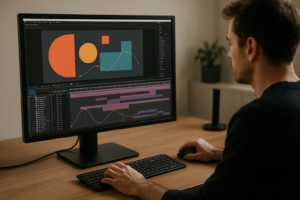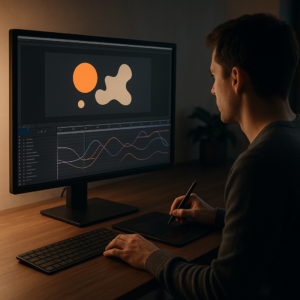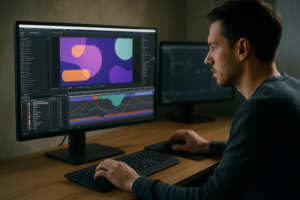

Lower thirds are often the first animated element viewers notice in a video, yet they are also the most rushed in production. This guide focuses on clear, practical lower thirds animation tips so you can design, organize and deliver consistent, professional graphics directly in After Effects without slowing down your edit.Explore lower thirds templates
📋 Table of Contents
Understanding the role of lower thirds
What lower thirds are
Lower thirds are on-screen graphics that usually appear in the lower area of the frame to show names, titles, locations, or short bits of context. In motion design and editing, they act as a bridge between visual storytelling and information.
Why lower thirds matter
Good lower thirds do three things:
- Clarify who is speaking or what viewers are seeing
- Add polish and brand consistency to a video
- Guide attention without stealing the scene
When lower thirds are clumsy, off-brand, or badly timed, they distract from the story. When they are well-designed, viewers barely notice them, yet the content feels more professional and easier to follow.
Who uses lower thirds
Lower thirds are essential for:
- Editors cutting interviews, documentaries, news, and explainers
- Motion designers building graphics packages and brand kits
- YouTube creators, streamers, and educators who need clear labeling
- Marketing teams producing ads, product videos, and case studies
Where After Effects fits in
Adobe After Effects is ideal for building reusable lower third systems. You can:
- Animate typography and shapes with precise keyframing
- Use expressions to automate behaviors like offsets or staggered reveals
- Pre-compose and export entire packs to reuse across projects
- Customize colors, fonts, and motion for different brands or shows
Core principles of lower thirds animation
Before going deep into techniques, it helps to frame lower thirds around a few core principles:
- Readability: text must be readable on any screen size
- Hierarchy: primary info (name) should beat secondary info (title)
- Timing: appear early enough to be useful, disappear before they become noise
- Subtlety: motion should feel confident and controlled, not flashy for its own sake
Everything else you do in After Effects—from easing curves to precomp structure—exists to support these fundamentals. Once those are clear, you can confidently build toward more professional lower thirds systems.
What makes professional lower thirds
Defining professional lower thirds
Professional lower thirds are not just about nice fonts and smooth easing. They are built to be:
- Consistent across an entire series or brand
- Flexible enough to handle long names, multiple roles, or language changes
- Fast to edit under deadlines
- Robust when handed between editors and motion designers
In practice, this means your After Effects setup needs more structure than a single cool-looking comp.
Common types of professional lower thirds
- Basic label bars: single-color rectangle with name and subtitle, ideal for corporate and educational content
- Minimal lines and text: thin rules and typography-only treatments, great for documentaries and cinematic work
- Brand-driven widgets: more complex structures that mimic UI (cards, tags, notifications), suited for tech or product-driven pieces
- Live content variants: lower thirds with space for dynamic data like social handles or locations
If you work with interface-inspired graphics, browsing projects such as the map-style widget templates can help you think of lower thirds as compact info panels rather than just name bars.
Matching style to content
Professional lower thirds always match the tone of the piece:
- Corporate and B2B: restrained, aligned to brand guidelines, predictable motion
- YouTube and entertainment: bolder, more playful, but still readable on mobile
- Documentary and news: minimal, clear, unobtrusive
- Music and creative pieces: more experimental, but still structured around legibility
Template-based workflows
Most teams working worldwide on tight timelines rely on templates. A professional lower third template should:
- Use master controls for color, typography, and spacing
- Be designed at standard resolutions (1920×1080 or 3840×2160) with flexible scaling
- Include well-labeled layers and controllers
- Handle edge cases like long titles without breaking
Even a more creative pack, such as a music-influenced widget like the lyrics-style animation, can serve as a base to build lower thirds that feel like part of a cohesive visual system.
Subtle motion vs loud motion
Professional lower thirds usually favor subtle motion:
- Short, confident slides or scales instead of big bounces
- Short fades with light overshoot, not cartoonish elasticity
- Timed accents synced with beats or dialogue pauses
The key is that motion supports message. Once you understand these variations, you can choose the right approach for each project and build a set of lower thirds that feels intentional instead of random.
Common mistakes when animating lower thirds
Overcomplicated animation
Many editors start by adding too many effects: excessive bounces, multiple wipes, glowing outlines. This slows renders and distracts viewers.
- Use one primary motion (slide, scale, or fade) as the base
- Add one secondary accent at most (line draw, icon pop, underline)
- Reserve heavier animation for hero titles, not lower thirds
Poor timing and pacing
Timing mistakes affect readability more than design:
- Lower thirds popping in after the speaker starts talking
- Graphics exiting before viewers can finish reading
- Animations that last longer than the on-screen time
Checklist for timing:
- Enter 4–8 frames before the subject speaks or appears
- Stay on screen long enough to read twice comfortably
- Exit 6–12 frames after the relevant moment ends
Ignoring the graph editor
Default linear keyframes make motion feel robotic. But extreme easing curves look amateurish too.
- Avoid 100/100 influence on all keyframes; it feels rubbery
- Use moderate ease-in on entrances, stronger ease-out on exits
- Preview with motion blur on to judge the real feel
Messy comps and naming
Sloppy project structure is a hidden pain point, especially on team projects.
- Layer names like “Shape Layer 45” and “Text 9” slow edits
- No precomps for repeated elements leads to manual updates
- No controller layers means you are color-picking everything by hand
Basic organization checklist:
- Group background shapes into a precomp
- Keep text layers clearly labeled (Name, Title, Tagline)
- Create a dedicated Control layer with color and spacing sliders
Unoptimized performance
Lower thirds should be light. Common performance killers:
- Unnecessary high-res textures and heavy blurs
- Multiple nested 3D layers for flat designs
- Large compositions for tiny interface elements
Before you render, disable anything that does not visibly contribute to the final look.
Ignoring safe areas and overlays
Lower thirds that look fine in a design tool can break when safe areas or platform overlays are considered.
- Keep key text away from the extreme edges
- Account for app UI, captions, and player controls
- Test on mobile and desktop to see how far up the frame you can go
By recognizing these patterns early, you avoid the usual rework cycle that eats into your editing time and budget.
Choosing the right lower thirds style for each project
Start with the edit, not the effect
Before animating anything, look at the project type and platform. Different outputs demand different lower thirds strategies.
Social reels and shorts
For vertical and fast-paced formats:
- Prioritize bold text and high contrast for small screens
- Use minimal horizontal width so names do not clash with UI elements
- Keep animations under 12 frames for entries and exits
YouTube and content channels
YouTube pieces often have recurring hosts, segments, or callouts. Here, professional lower thirds should support a channel identity:
- Use a reusable pack of lower third variations for guests, hosts, and topics
- Keep transitions consistent with other on-screen widgets, like a YouTube-style info widget
- Design with both desktop and mobile playback in mind
Ads, product videos, and promos
For commercial work, lower thirds must align with brand guidelines yet stay flexible for last‑minute text changes:
- Build typography styles that match the brand kit
- Use solid color blocks or subtle gradients compatible with product shots
- Test legibility against varied backgrounds early in the design phase
Documentary, news, and interviews
These formats typically call for discreet, reliable graphics:
- Use restrained motion with clear type hierarchy
- Maintain consistent color use for roles (e.g., experts vs hosts)
- Ensure legibility on archival footage and low-contrast shots
When templates make sense
Once you are clear on the project type, templates become a strategic tool rather than a shortcut. An Unlimited After Effects Templates Subscription is most useful when you regularly need:
- New looks that still follow strong readability rules
- Different lower thirds styles for multiple brands or series
- Modular components you can mix with other animated widgets
For visual reference and inspiration, browsing motion graphics on Dribbble can help you see how others handle hierarchy, color, and spacing in small UI-like elements.
Decision framework
When choosing or designing a lower third, ask:
- What is the primary job of this graphic: label, highlight, or brand?
- How long will it be on screen on average?
- Where might platform UI or captions overlap it?
- Can I achieve this with clean shapes and type, or do I truly need textures and 3D?
Answering these questions keeps your creative choices grounded in what the edit actually needs, rather than what looks impressive in isolation.Find the right style pack
Practical workflow guide for template based lower thirds
Start with the right project settings
Before you drop any template into a timeline, align core settings:
- Resolution: Most lower thirds are built for 1920×1080 or 3840×2160. If your sequence is different (e.g., vertical 1080×1920), create a dedicated comp and adapt the design.
- Frame rate: Match the template fps to your edit (23.976, 25, or 29.97 are typical). Mismatched frame rates create stuttery or off-beat motion.
- Color space: If you work in a managed color pipeline, make sure the template is not assuming a different gamma curve.
Check version compatibility
Professional lower thirds templates should specify minimum After Effects versions. If you open a project built for a newer version:
- Test all expressions and precomps for errors
- Make a lightweight duplicate project before heavy edits
- Disable unsupported effects or replace them with native equivalents
When you explore a motion graphic like the card-based animation project, pay attention to how controllers and expressions are organized; you can mirror the same structure in your lower thirds system.
Organize precomps and naming
Think of your lower thirds as a mini design system inside After Effects:
- Use a clean folder structure (01_MAIN, 02_PRECOMPS, 03_ASSETS, 04_RENDERS)
- Name precomps logically: LT_NameBar, LT_TitleBar, LT_Bug, LT_Global_Controls
- Keep a master control comp where you can set brand colors and fonts once
Keyframe structure and timing
Professional lower thirds have predictable timing that you can reuse across edits.
- Build entrance animation around 10–18 frames for standard content
- Use 8–12 frames for exits to keep the edit snappy
- Keep keyframes aligned to clear frame numbers (e.g., 0, 6, 12, 18) to make offsets easier
Stagger motion of different elements slightly:
- Background bar: first to appear
- Name text: 2–3 frames later
- Title/subtitle: 2–3 frames after name
Performance and preview tips
Lower thirds often appear over full-res footage, so performance matters.
- Use lower preview resolutions (Half or Third) when testing motion
- Turn off motion blur until the animation is locked, then enable on key layers
- Pre-render highly complex lower thirds as alpha-matted ProRes or similar if they slow the whole timeline
- Keep disk cache healthy and purge if previews start stuttering
Plugin dependencies and safe alternatives
If a template relies on third-party plugins:
- Decide if you can maintain those plugins across all machines and collaborators
- If not, replace plugin-driven effects with native equivalents (for example, using native blur and glow instead of heavy third-party stacks)
- Avoid building core branding elements around fragile plugin setups
Customization workflow
When adapting a template to your brand or client:
- Colors: Drive them through one or two master controls, not per-layer tweaks
- Typography: Create paragraph and character styles where possible, and stick to 1–2 fonts
- Spacing: Use expression-linked padding where feasible to handle long names without manual nudging
- Timing: Use markers on the timeline to define in/out zones, then align keyframes to these markers
Use-case specific setups
Different outputs may use variations of the same base template:
- Reels and shorts: A compact, centered tag version with larger type
- Product promos: Lower thirds that can double as feature callouts or price tags
- Cinematic edits: More restrained color and soft motion, perhaps borrowing a subtle effect similar in spirit to the glass-like overlay animations for delicate highlights
Practical checklist for each new project
- Confirm fps, resolution, and color settings
- Duplicate the template project and rename for the client or series
- Set brand colors and fonts in the master controls
- Create at least 3 variants: guest lower third, host lower third, topic label
- Test all variants on bright and dark footage
- Render short preview clips to share for approval before rolling out across the edit
When done well, a single professional lower thirds system can support dozens of edits, which is where an Unlimited After Effects Templates Subscription becomes particularly valuable: you can keep updating and expanding your system without starting from scratch every time.
Advanced tips for scalable lower thirds systems
Design for consistency across the whole edit
Instead of treating each lower third as a one-off, think in terms of a system:
- Create a style guide inside your project that defines sizes, colors, and motion rules
- Apply the same easing values and durations to all related elements
- Use a single control comp to drive colors and text styles for the entire series
Look at a widget pack like the editing-style UI templates to see how multiple components can share a visual language yet serve different purposes.
Reusable animation rigs
Professional lower thirds workflows often rely on reusable rigs:
- Link text and background widths using expressions so the bar reacts to content length
- Use null objects to control the whole lower third position and scale
- Build one core entrance/exit animation and instance it via precomps for variations
Styleframes and approvals
Before animating an entire pack of lower thirds, design a small set of styleframes:
- Show name + title variations
- Demonstrate the graphic over different footage types
- Include one or two alternate layouts (left-aligned, right-aligned, center)
Getting approval on static frames first saves significant animation time.
Modular transitions and accents
Consider building small re-usable accents:
- Short underlines that can be reused in titles and callouts
- Icon pop-ins that can show social handles or categories
- Subtle wipes or masks that can reveal or hide the whole lower third on cuts
This keeps your toolkit broad without bloating the project.
Quality control pass
Before sending graphics out:
- Check that all names and titles are fully readable in multiple resolutions
- Verify that motion is consistent across all variants
- Ensure all text layers use the correct spelling and casing conventions
- Scan for stray keyframes or disabled layers that might break in future edits
Export and render considerations
For delivery:
- Use lossless or visually lossless codecs with alpha (ProRes 4444, for example) if you are handing elements to another editor
- Double-check premultiplied vs straight alpha settings for clean edges
- If rendering directly from the edit via dynamic link, keep After Effects comps as light as possible to avoid slowdowns
Dynamic link and project weight
Dynamic link between Premiere Pro and After Effects is useful, but heavy lower thirds setups can cause lag.
- Limit the number of unique comps dynamically linked at once
- Consider pre-rendering heavy sequences and replacing them with video files
- Archive unused assets and purge older precomps to keep the project lean
Long-term maintenance
For recurring clients or ongoing series:
- Keep a versioned master template and document changes
- Maintain a short “how to” note inside the project so other editors know where to customize text and colors
- Schedule occasional cleanups to remove outdated variants and keep only what the team actually uses
Over time, this approach turns your lower thirds from a single asset into a durable, scalable system that supports many episodes, campaigns, or channels without constant reinvention.
Search driven questions about lower thirds and motion design
Understanding user search intent
Editors and motion designers often search for very specific topics when dealing with lower thirds. Addressing these quickly can save time in production. Below is a list of common questions and concise answers aligned with professional lower thirds workflows.
- How long should a lower third stay on screen?
Typically long enough to read the information two times comfortably. For most content, that means 3–5 seconds, depending on text length and pacing. - What is the best font size for lower thirds?
For 1080p sequences, names are often in the 42–60 px range, with titles around 28–40 px. Always test on smaller screens and adjust tracking for readability. - How do I avoid lower thirds covering subtitles?
Design your safe zone a bit higher than the absolute bottom edge. Test with sample captions and adjust vertical placement to avoid overlap. - What is the fastest way to update many lower thirds?
Use a single master comp with text layers driven by Essential Properties or a control panel. Updating text and global styles in one place is much faster than editing each comp manually. - Can I reuse broadcast style lower thirds for YouTube?
Yes, but simplify. Reduce clutter, increase font size, and adapt timing for shorter attention spans. Also ensure they look good on mobile in both portrait and landscape orientations. - Are 3D lower thirds worth it?
Only when the piece is heavily stylized or demands 3D integration. For most workflows, clean 2D or faux-3D shadows are faster, lighter, and easier to maintain. - How do I match lower thirds to brand guidelines?
Use the exact brand fonts and color values, then build a small library of approved variants (guest, host, location). Keep a reference image or PDF in your project as a visual checklist. - Why do my lower thirds flicker on export?
Common reasons include very thin lines at small sizes, interlaced exports, or scaling in the NLE after rendering. Slightly thicken strokes, export progressive, and avoid scaling rendered graphics in post. - What is the best place to position lower thirds?
Start from the lower left or lower right, then nudge up until they clear any graphics, captions, or UI. Avoid extremes near the edge to reduce cropping issues on different displays. - How do I keep lower thirds consistent across multiple editors?
Share a single, documented template with locked-in styles, create a short usage note, and store it in a central location. Encourage everyone to duplicate, not overwrite, the master.
These brief answers cover some of the most frequent search-driven concerns, helping you refine both your lower thirds animation tips and your overall motion design workflow.
Bringing it all together for efficient lower thirds
Recap of key principles
Effective lower thirds are clear, consistent, and respectful of the viewer’s attention. They rely on:
- Strong readability and hierarchy
- Purposeful, understated motion
- Clean project structure and naming
- Templates that are easy to adapt across multiple edits
From one off graphics to a reusable system
By organizing your comps, building master controls, and aligning animation timing, you shift from crafting isolated lower thirds to managing a professional system that supports your entire workflow.
Faster, cleaner, more consistent results
Whether you are cutting interviews, launching a YouTube series, or delivering branded content for clients worldwide, disciplined lower thirds workflows save time and reduce revisions. Pairing your own expertise with an Unlimited After Effects Templates Subscription gives you a constantly evolving toolbox, so you can focus on storytelling while still delivering polished, professional lower thirds on every project.
When you are ready to scale your graphics library and speed up delivery, explore curated packs designed specifically for editors and motion designers working in After Effects.Browse lower thirds options
Conclusions
Lower thirds succeed when they serve the story first and the design second. With clear hierarchy, smart animation choices and organized templates, you can move quickly while keeping every project cohesive and polished. Treat your lower thirds as a reusable system and they will support your edits, rather than slowing them down.
FAQ
What is the ideal duration for a lower third animation in After Effects?
Keep the entrance and exit animations between 8 and 18 frames each, then hold the static state long enough for viewers to comfortably read the text twice.
How can I make lower thirds more readable on mobile screens?
Increase font size, boost contrast, simplify shapes, and test on an actual phone screen. Avoid extremely thin fonts and keep text away from screen edges and app UI elements.
Do I need plugins to create professional lower thirds?
No. Native After Effects tools are enough for most professional lower thirds. Plugins can add flair, but clean typography, solid timing, and good organization matter more.
How do I keep multiple lower thirds consistent across a series?
Use a master control comp for colors and typography, set standard durations and easing, and duplicate a single approved template rather than designing new graphics for each episode.
What export format should I use for lower thirds with transparency?
Use a codec that supports alpha channels, such as ProRes 4444 or similar, with straight or premultiplied alpha configured correctly to avoid unwanted edges.
Can I adapt one lower third template for multiple brands?
Yes. Build your template with global color and font controls so you can quickly swap branding while keeping the same motion and layout structure.